“You’re All Already Dead!”
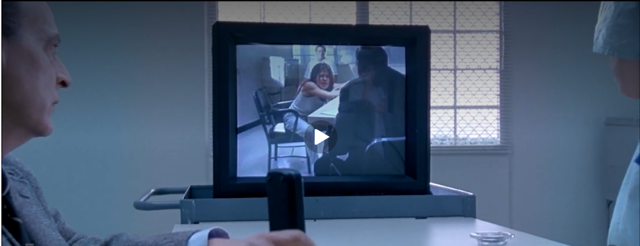
Last week, I had the occasion to attend the College of Computing and AI’s new film screening series “AI In Cinema”. Hosted by CDIS commons Director, Rebecca Millerjohn, the series is a wonderful initiative meant to bring students and faculty from all disciplines together to see how science fiction has depicted AI and how this links to our current moment. We were watching Terminator 2: Judgement Day, with opening remarks by Dr. Derek Johnson (a Communication Arts professor who runs a wildly popular AI in Story and Screen) and Dr. Jerry Zhu (a Computer Science professor who provided a pre-recorded video for the event, complete with him turning himself into liquid mercury to walk through fence, mimicking one of the film’s notable scenes). During the screening, I was particularly struck by one scene in a psychiatric institution, in which Sarah Connor (played by Linda Hamilton) is forced to re-watch video footage of herself re-telling her apocalyptic dream where AI and robotic invasion results in the full on destruction of humanity while hospital staff dismiss her claims and forcibly restrain and sedate her. The scene hit me differently than previous times I’ve seen the film. I was struck by the similarity of the content of her outburst (“You’re all already dead!”) to the many interviews and outlandish claims we’ve seen from tech CEOs over the last few months; claims that are not only left unchecked, but promoted through constant circulation in the news media and online.
Terminator 2 was selected as the first film in the series since it coincided with Halloween and since it was the “scary” AI-takes-over-the-world narrative trope. Dr. Zhu’s opening video noted what the film “predicted” and what it “got wrong”. But there’s so much more we can say about science fiction than whether or not science achieved what science fiction dreamt up. As Dr. Johnson reminded us in his introduction to the film, the movie is less about AI destroying humanity than it is about AI learning its own limits the more it interacts with humans. Unable to comprehend human feelings and behavior, Arnold Schwarzenegger’s terminator struggles to relate and perform its duties to protect Sarah and John Connor because of the uncertainties and unpredictabilities that lived human experiences introduce. The terminator tries to learn throughout the film, and certainly collects enough data to provide a more accurate assessment of feelings”. But in the end, when the immediate threats are (at least temporarily) melting away, it’s the connection between humans and their technologies that persist.
The shape and impact of AI technologies (like so many previous “new” technologies) is as much science as it is science fiction. It’s impossible to understand the technology without understanding the culture that has shaped the technology (such as the filmic, literary, and televisual representations of technology). These mediate consumer understandings and experiences of technology just as much as, if not more than, their understanding of how a neural network works. This is precisely why privileging one field of study over others to address a technology that cares little about disciplinary boundaries is a missed opportunity. And it’s why we need more connections and conversations between humanities/social science scholars and the scientists, engineers and programmers working on the technologies directly, like Millerjohn is trying to foster.
Jeremy Morris
Faculty Director, AI&U