Introducing Our 2027 Internal Fellows
The Center for Humanistic Inquiry into AI and Uncertainty is pleased to announce the results of its second annual competition for Resident Fellowships for UW–Madison faculty who are working on projects that explore AI technologies from a humanistic (or descriptive social scientific) perspective. The theme for this year’s call was “AI and Creativity.” The Center’s selection committee–comprising its steering committee and members of its advisory board–selected 4 fellows for 2027. Resident fellows receive time and funding so that they may undertake full-time research, participate in the Center’s intellectual community and meetings, collaborate on the publication and dissemination of the Center’s annual whitepaper, and contribute to the Center’s other activities.
We are pleased to announce that the recipients of the inaugural fellowships are:
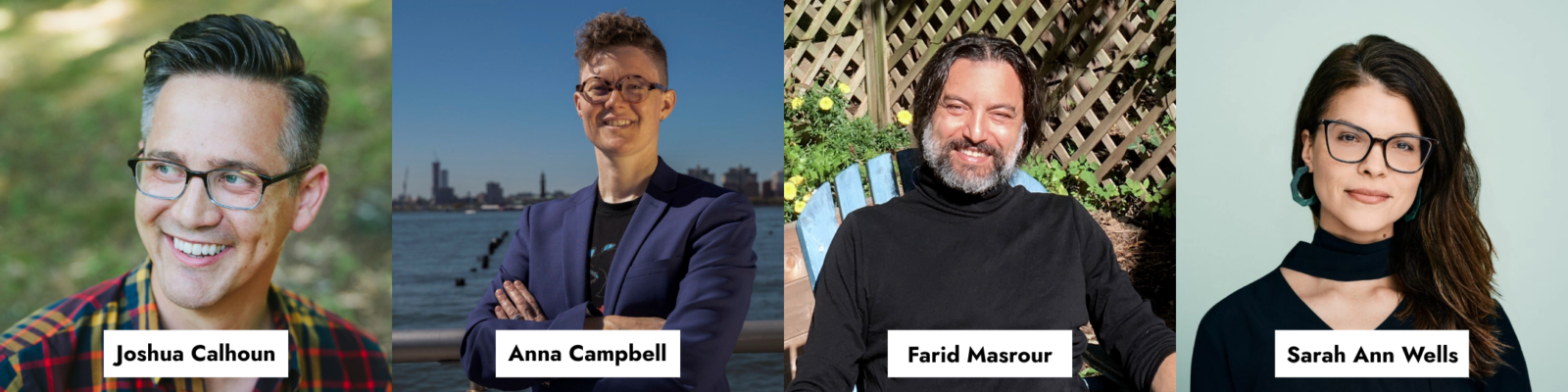
Joshua Calhoun, Professor, Mellon Professor in the Humanities, Department of English. Dr. Calhoun’s project “The Hand and the Chatbot: How Students Invent in the Age of AI” seeks to understand what the next generation of creative thinkers will make with a formidable new tool. Calhoun will analyze two rounds of student/classroom data with his research team and explore how students are using AI chatbots, among other tools, to read, write, borrow, and create.
Anna Campbell, Professor, Professor of Gender & Women’s Studies and Art, Department of Gender & Women’s Studies. Prof. Campbell’s project, “What Was I Made For? Using AI Technology as a Tool for Art – A Praxis-Based Research Approach to Creativity,” will examine what it means to use AI as part of artists’ creative workflows. Prof. Campbell’s project takes a praxis-based approach to engaging directly with vernacular AI tools available to the general public as a means of addressing the question of artistic creativity. The project will result in a video art project for exhibition in galleries and at film festivals.
Farid Masrour, Professor of Philosophy, Department of Philosophy. Dr. Masrour’s project, “Creativity as Capacity: Making, Meaning, and AI,” seeks to answer what it means to attribute capacities (perceptual, cognitive, creative) to people and to machines. Masrour’s project argues that the deepest threat AI poses to creativity is not a world without creative products but a world with fewer creative lives, where a creative life is one that involves the exercise of creative capacities. This is a dimension of uncertainty about the future that current discussions of AI have largely overlooked: whether a life increasingly shaped by AI will be a less meaningful one.
Sarah Ann Wells, Professor, Mark Williams Eccles and Elisabeth Norris Eccles Professor, Department of English. Dr. Wells’ project “Translationships: Literary Translation in the Age of AI,” examines what is gained and lost when literary translationships – the relationships that form between translators and their authors, as well as within authors when they are themselves translators – are altered via generative AI. Wells will research the problem of machine-generated and computer-assisted literary translation on two fronts, with scholarly articles and public-facing publications. She will also engage with the recent shift in, and beyond academia, whereby translation—long sidelined in discussions of creativity and artistic labor by both creative authors and literary scholars— is gaining prominence.
These 4 new internal fellows will join the Center’s current External Fellow (Nell Haynes, St. Mary’s University “Changing Meanings and Values of Art in the Context of AI Image Generators.”) and the Graduate Student RA (Lucy Quanxin Yang, Political Science, “Decentralization Before Blockchain.”)
The Center for Humanistic Inquiry into AI and Uncertainty serves as a collaborative hub for gathering people, ideas, and resources from across UW–Madison in order to intervene in scholarly and public debates around the significant uncertainty emerging AI technologies generate. AI’s uncertain futures require thinking beyond purely technological solutions and simplistic, context-independent value frameworks. Our goal is to foster holistic research that focuses on AI’s socio-technical dimensions and considers context-sensitive values such as equity, trustworthiness, transparency, privacy, and civil rights. The Center is only possible thanks to a wide range of partners, and funding from an NEH grant in Humanities Research Centers on Artificial Intelligence. The Center thanks the College of Letters & Science, the Office of the Provost, the Office of Vice Chancellor for Research, the Graduate School, the Institute for Research in the Humanities, the Center for the Humanities, UW–Madison Libraries and the Data Science Institute for their support. For more information see https://aiuncertainty.wisc.edu.